
⛏️ See How an 1892 Gold Rush Outfit Survived the Unmapped Yukon!
Four years before the 1896 Klondike Gold Rush, pioneer Thomas R. Bennington hauled his 1892 gold rush outfit over Chilkoot Pass and built a wooden boat at Lake Lindeman. On his 700-mile voyage down the Yukon River, he floated right past unaware of billions in untouched Klondike gold!
Featuring 26 custom Gaia GPS maps and original ledger photos, our book is an 🔥 Amazon Top 50 Best Seller. Watch the true story from Before the Klondike: The 1892–1893 Journals of Thomas R. Bennington below:
✍️ Order a Hand-Signed Copy of “Before the Klondike” (Use code KLONDIKESAVER for $10 OFF!)
📦 Or Buy on Amazon (Hardcover, Paperback & Kindle eBook – Affiliate Link)
🗺️ Explore the 1892 Pioneer Trail | 📚 See Top Books Like Klondike Fever
As an Amazon Associate, Hitched4fun earns from qualifying purchases.
First, what did an authentic 1892 gold rush outfit actually look like before the famous 1896 Klondike stampede? Specifically, in the spring of 1892, our 3rd great-grandfather, Thomas R. Bennington, packed a heavy wooden and leather chest for the wild Yukon River. Today, modern gold prospecting enthusiasts pack lightweight gear right into their RV storage bays.
However, the core science of finding placer gold has barely changed in over 130 years. Therefore, let us compare an authentic 1892 gold rush outfit from our family’s handwritten pioneer diary with the modern gear we use at Hitched4fun.com!
What Was Inside an Authentic 1892 Gold Rush Outfit?
When Thomas R. Bennington boarded the steamship City of Topeka at San Francisco in May 1892, frontier trading posts were already established along the route, and prospectors shuttled their gear over Chilkoot Pass using sleds, relay packing, and hired Tlingit packers rather than hauling a mandatory year’s rations unaided on their own backs.
In fact, according to the handwritten ledger inside Before the Klondike: The 1892–1893 Journals of Thomas R. Bennington, a complete 1892 gold rush outfit weighed over 1,000 pounds:
- Stamped Steel Gold Pan: First, 1892 miners carried a heavy, smooth-sided steel pan. Furthermore, they had to burn off factory grease in a campfire so natural oils would not cause fine gold to float away.
- Hand-Hewn Wooden Rocker & Sluice Boards: Second, pioneers whipsawed green spruce trees at Lake Lindeman to build their own wooden sluice boxes and rockers.
- Cast Iron Dutch Oven & Skillet: Third, every 1892 camp relied on heavy cast iron to bake sourdough bread, roast moose meat, and boil beans over open embers.
- Canvas Wall Tent &Yukon Stove: Fourth, miners slept under canvas sheets while temperatures plunged to 80 degrees below zero at Fortymile.
- Chamois Leather Gold Poke: Finally, without plastic snuffer bottles, 1892 prospectors dried their black sand in a skillet, blew away the dust, and stored gold in a stitched leather poke.
Side-by-Side Comparison: 1892 Gold Rush Outfit vs. Modern RV Gear
While Thomas R. Bennington had to fight rusted iron pans and freezing river water, today’s RV prospectors can process paydirt ten times faster. Below, see how each tool in an 1892 gold rush outfit compares to modern RV prospecting equipment:
| Prospecting Task | 1892 Gold Rush Outfit | Modern Hitched4fun RV Gear |
|---|---|---|
| Primary Gold Panning | Heavy stamped steel pan (rusted easily, zero riffles) | 14″ GPAA Gold Pan or The 1849 Gold Pan (deep riffles, high-contrast green) |
| Gravel Classification | Hand-picking rocks or punched tin riffles | Gold Buddy Classifier & Classifier Bundle (304 stainless mesh) |
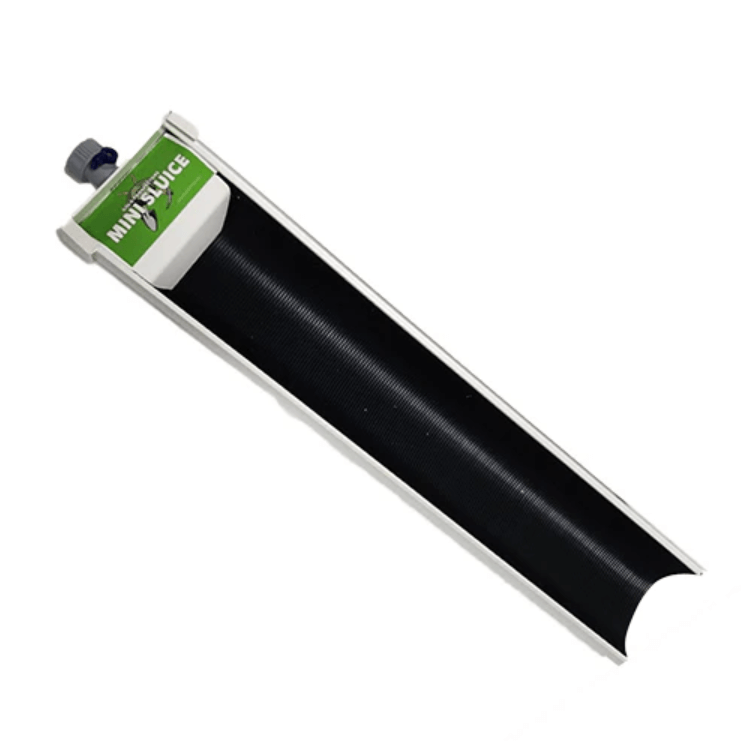
| Fine Gold Recovery | Whipsawed wooden rocker box fed by hand buckets | Gold Magic 12-E Spiral System Kit or GPAA Mini Sluice |
| Stopping Float Gold | Burning pan grease in a campfire | Gold Magic Drop (2 drops break water surface tension instantly) |
| Black Sand & Cleanup | Blowing dry sand off a tin plate by breath | Black Sand Magnet, 4 oz Snuffer Bottle & Suction Tweezers |
| Campfire Cooking | Heavy cast iron pot over Yukon spruce coals | Lodge Cast Iron Camp Dutch Oven (still unbeatable after 130 years!) |
5 Modern Upgrades Every RV Prospector Should Pack
If Thomas R. Bennington could step out of 1892 and inspect our RV storage bay today, five tools would amaze him most:
1. High-Contrast Riffled Polymer Gold Pans
First, in 1892, dark steel pans made dark magnetite black sand nearly invisible. Today, our 14″ GPAA Gold Catcher Pan, Archer Blue 10″ Pan, and Archer Pink 10″ Pan make both yellow gold and black sand pop in the sunlight.
2. Stackable Stainless Steel Bucket Classifiers
Second, panning large river stones and microscopic flour gold together causes heavy rocks to knock fine gold right out of the pan. Fortunately, stacking our Gold Buddy Classifiers over a 5-gallon bucket sizes your gravel in seconds.
3. The Gold Magic 12-E Spiral Wheel & Mini Sluice
Third, Yukon pioneers spent weeks sawing lumber just to build a single sluice box. In contrast, our battery-powered Gold Magic 12-E Spiral System and GPAA Mini Sluice Concentrator set up right on your picnic table in two minutes.
4. Black Sand Magnets, Snuffer Bottles & Gold Magic Drop
Fourth, fine flour gold along the Yukon, Fortymile, and California rivers loves to float on top of water. By adding two drops of Gold Magic Drop, pulling iron out with a Black Sand Magnet, and vacuuming gold with our GPAA Mini Starter Kit, you never lose a speck.
5. What Has Not Changed Since 1892: Cast Iron Dutch Ovens!
Finally, one piece of an 1892 gold rush outfit remains 100% unchanged today. After a long day panning the creek, nothing beats baking hot cobblers, stews, or sourdough bread in a genuine Lodge Cast Iron Camp Dutch Oven!
Frequently Asked Questions About an 1892 Gold Rush Outfit
1. How much did an 1892 gold rush outfit cost?
First, in 1892, outfitting a year-long expedition in Seatle, San Francisco or Juneau cost roughly $300 to $500—equivalent to over $15,000 today.
2. Why did 1892 pioneers miss the Klondike goldfields?
Specifically, as documented in Before the Klondike, It wasn’t pitch darkness—sub-Arctic mid-July has perpetual twilight from the midnight sun. Pioneers simply bypassed the Klondike River because all proven strikes and supply posts were 40 miles downstream at Fortymile.
3. Where can modern RVers pan for gold legally today?
Finally, by joining the Gold Prospectors Association of America (GPAA), you gain access to hundreds of legal gold claims across Alaska, California, Arizona, Oregon, and Washington!
Ready to build your own modern prospecting kit? Shop our complete Gold Prospecting Equipment Collection and add a hand-signed copy of Before the Klondike (use code KLONDIKESAVER for $10 OFF) to your order today!